
Why Foreign Talent Leaves Japan Within 3 Years: The Tax Barrier
A practical guide to the tax barriers that affect foreign talent retention in Japan, covering resident tax, income tax, year-end adjustment, and procedures when leaving Japan. It also looks at what employers and local communities can do.
Why Foreign Talent Leaves Japan Within 3 Years
When foreign talent leaves Japan early, the reason is not always the job itself. Often, it is the accumulation of small uncertainties in everyday life: housing, language, paperwork, and especially taxes. METI’s Future Human Resources Vision shows that retention is a serious issue for foreign talent, and that many regional companies do not have dedicated HR staff to explain systems clearly. That means the first months after hiring are especially important.
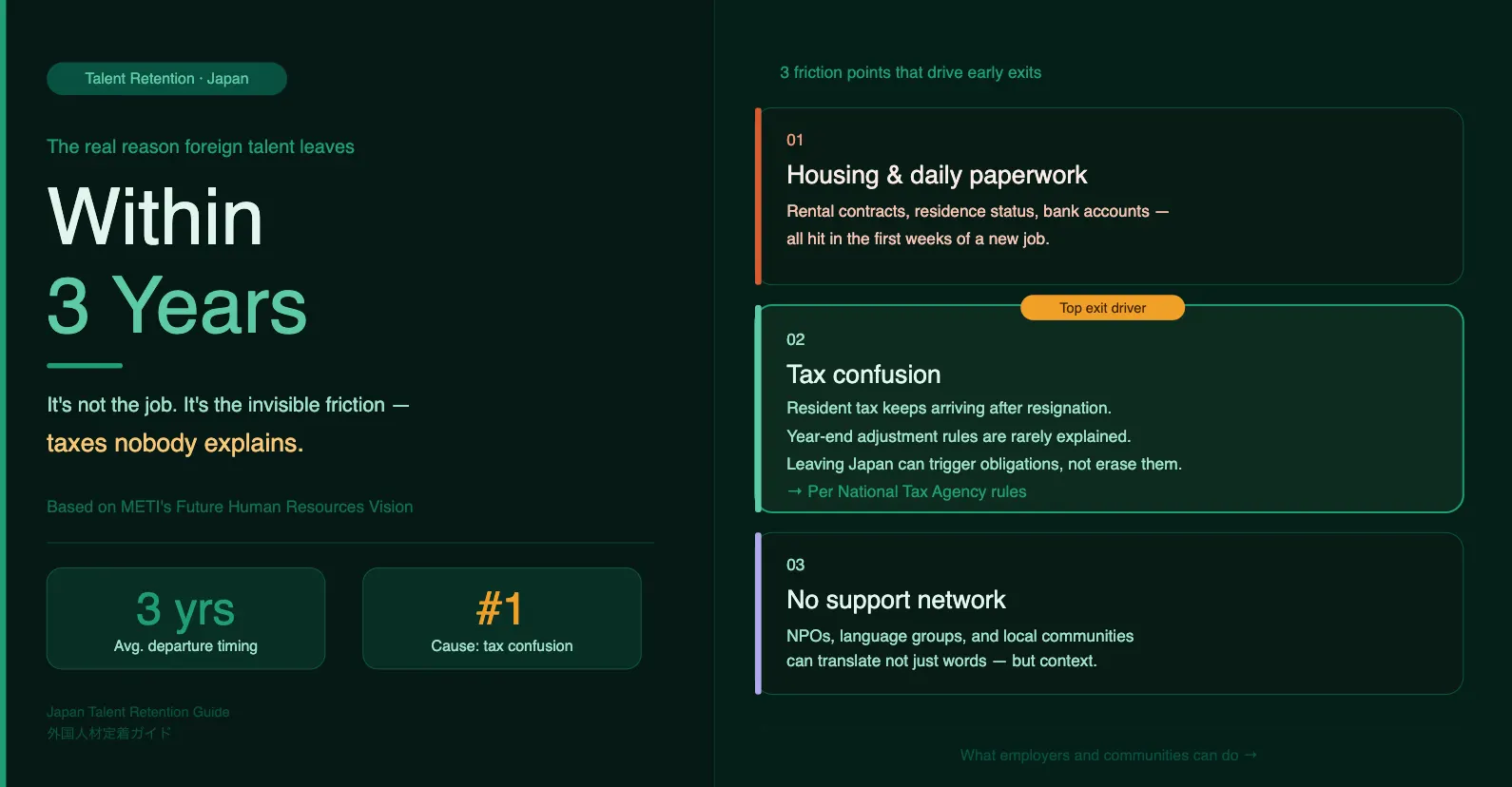
Tax Issues That Cause Confusion
Taxes are one of the fastest ways for trust to break down if they are not explained well. In Japan, resident tax, income tax, year-end adjustment, and departure-related procedures each work on different timelines. For a new resident or employee, that can feel like multiple systems appearing at once, especially when the person is also trying to adapt to a new workplace and a new daily life.
Income Tax, Resident Tax, and Year-End Adjustment
Resident tax is a common source of confusion because it can still be billed after someone resigns or returns home. The National Tax Agency explains that a foreign employee who retires and returns home may still be assessed resident tax. In plain terms: leaving the job does not always mean all tax obligations end immediately.
Income tax works differently, but it can still surprise people. If an employee is transferred overseas for one year or more, they are generally treated as a non-resident under Japanese tax rules. In that case, the employer must perform year-end adjustment before departure if the conditions are met. The NTA also explains that when someone who had become a non-resident later returns to Japan, they again become a resident, and their taxable income changes accordingly.
Leaving Japan: Tax Procedures and Exit Tax
There is also the issue of departure-related taxation. Japan’s “exit tax” system applies only under specific conditions, including cases where a person leaving Japan holds certain assets above a defined threshold. Many foreign workers will never be affected by it directly, but it is still worth mentioning because it shows an important principle: leaving Japan can trigger tax procedures, not erase them.
What Employers Can Do to Support Retention
The practical answer is not to turn every manager into a tax expert. The real need is clarity. Employers can prepare a simple checklist in English and Japanese, explain when resident tax starts, explain what year-end adjustment means, and tell employees whom to contact when they plan to resign or leave Japan. In regions where dedicated HR staff are limited, this kind of structured communication matters even more. METI’s own materials point to the lack of dedicated personnel as a challenge, which makes good information design a retention tool, not just an administrative task.
How Local Communities Can Help Foreign Residents Stay
Retention is not built only inside a company. It is also shaped by whether a person feels they can ask questions in the wider community. NPOs, local associations, language exchange groups, and international career communities can help translate not just words, but context: how taxes work, when forms matter, and why a bill may arrive after someone has already left a job. That kind of support reduces anxiety and makes Japan feel more livable.
Foreign talent will not stay simply because a job exists. People stay when they understand the system, feel respected, and know where to ask for help. Tax support is part of that bigger picture. If companies and communities make the invisible parts of life more understandable, Japan becomes a place where more people can build a future here.
Red Look is a community where Japanese and non-Japanese members learn together, exchange ideas, and support one another. If you care about international careers or building a life in Japan, you are very welcome to join us.
NPO法人 Red Look
日本人、外国人双方の国際キャリア形成を通じた
持続可能な地域共生を目指して
Recommended for you
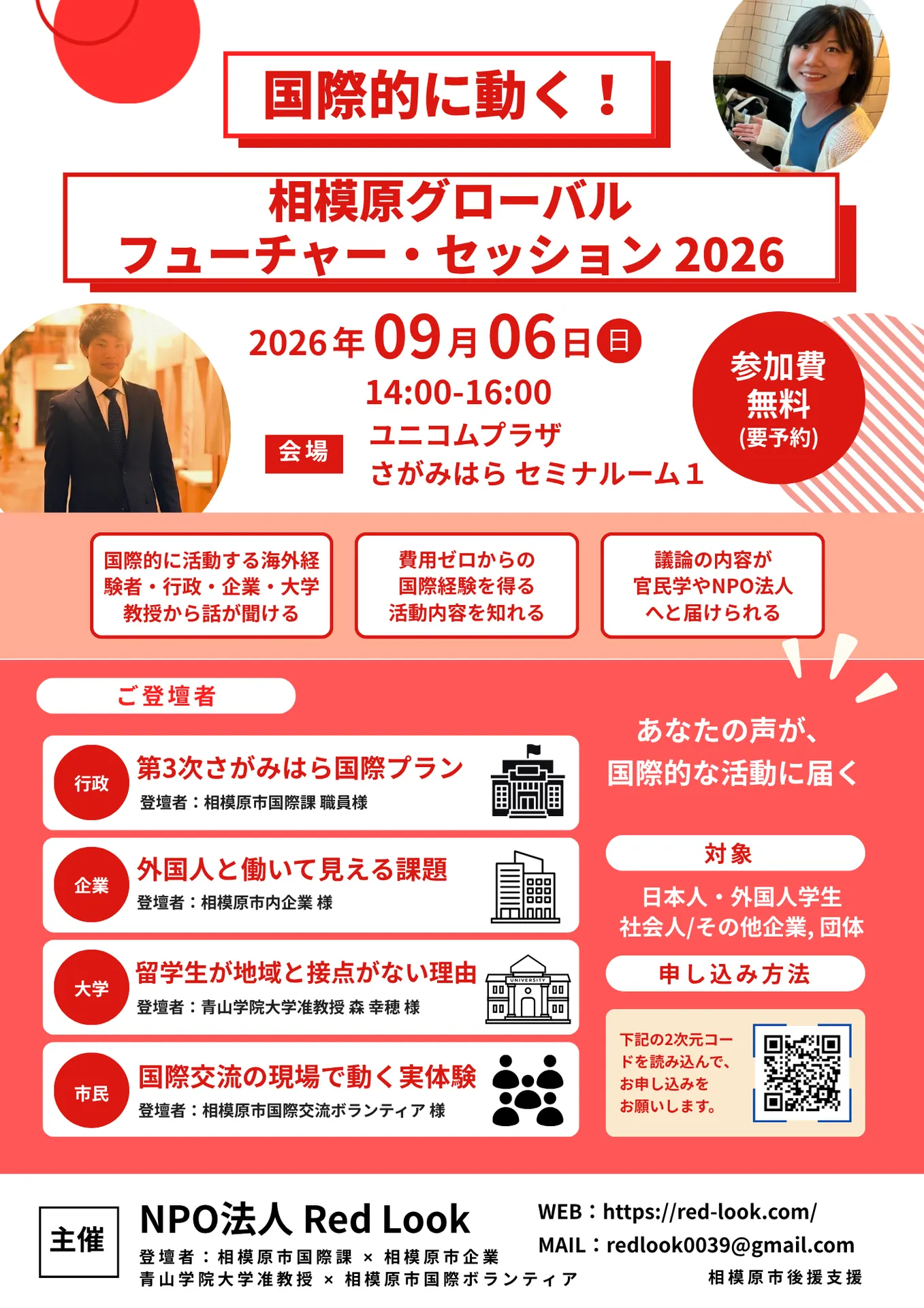
Sagamihara Global Future Session 2026: Connecting Multicultural Communities and Global Careers
2026-07-08
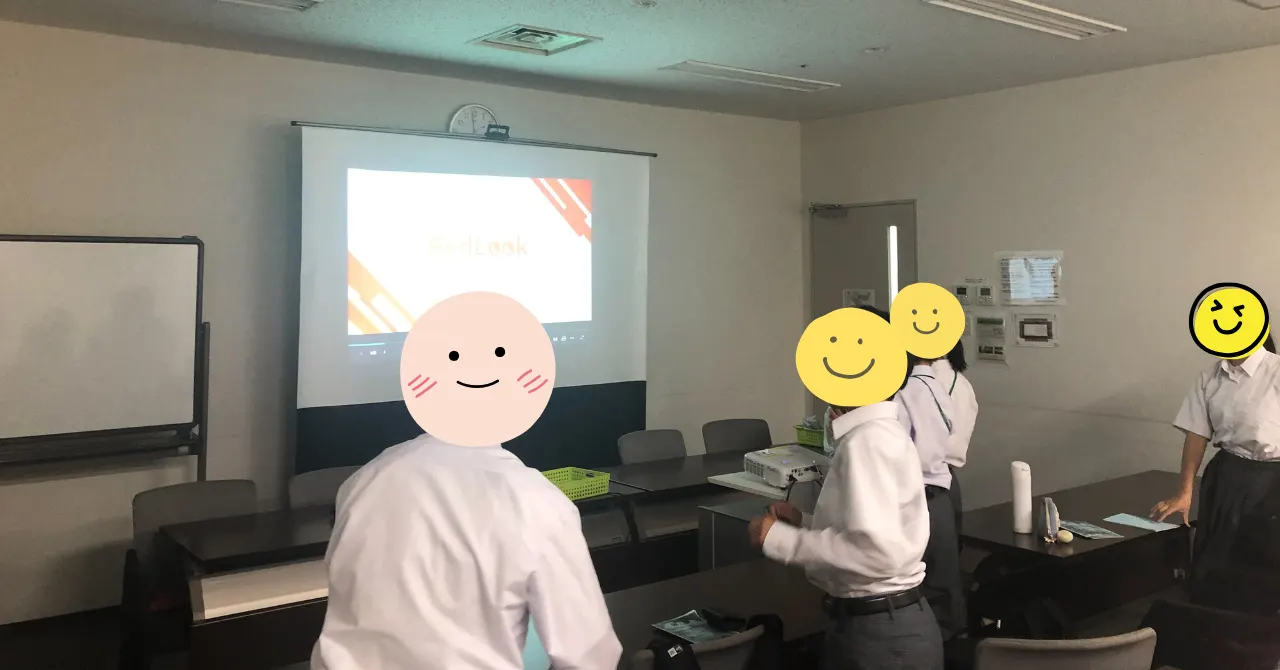
Connecting Junior High School Students with the World | Red Look Delivers an International Understanding Class in Sagamihara
2026-07-03

Studying Japanese but Can't Use It at Work? Red Hub Bridges Language Learning and Your Career in Japan
2026-04-17
Red Look's Next Chapter: Online Community, Government Partnerships, and a City-Endorsed Event in Sagamihara
2026-04-17

Why We Rebuilt Our Vision: From 'Local Job Support' to 'A World Where Everyone Can Connect Globally'
2026-04-16
Interested in working or studying abroad? We’re here to support you.
Red Look is a non-profit organization that helps Japanese individuals take on overseas challenges and supports foreign nationals finding careers in Japan. Our mentors and career coaches will guide you through your global journey. Reach out today!
Get Free Consultation