Blog
First Online Language Exchange? What Happens in 45 Minutes
Not sure your Japanese is good enough, or what to say? Here is what happens in a 45-minute Japanese–English online exchange, with real topics and what 28 participants told us.
 By Eric (Yutaro Akami)Representative Director, NPO Red LookPublished:
Contents
Short answer: For your first online language exchange you do not need fluent Japanese. You need a short self-introduction and the courage to say "Sorry, one more time?" In a small group with a topic and a host, you will rarely run out of things to say.
This guide uses the weekly online exchange run by NPO Red Look, a nonprofit based in Sagamihara, Kanagawa, as an example: what happens in the 45 minutes, the topics we actually used, and the worries first-timers bring with them.
One-on-one apps vs. a hosted group
There are two common ways to do a language exchange online.
| Format | How it works | Good for |
|---|---|---|
| One-on-one in an app | You find a partner yourself and chat or call | People who want a steady partner and their own pace |
| A hosted group (online or in person) | An organizer sets the time and topic; a host guides the conversation | People who are not sure what to talk about, or want to try it once first |
Apps are convenient, but you have to find partners and create topics yourself. If "what do I even say?" is the thing stopping you, a hosted group is the easier first step.
What happens in 45 minutes
Red Look's weekly online exchange runs on Google Meet and lasts about 45 minutes. The day and time change from week to week, so each session is announced on Meetup. A typical session looks like this:
- Hello and introductions. Join the call and introduce yourself briefly.
- Talk about the topic. The host shares a slide with the topic, and you talk in a small group. We split the time roughly half in Japanese and half in English.
- One-line wrap-up. Everyone shares one thing they talked about or noticed.
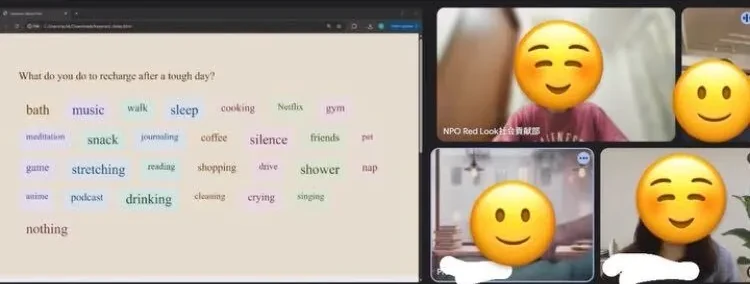 The weekly online exchange on Google Meet (faces hidden)
When someone joins for the first time, the host's first words are simple: thank you for coming, and we hope you enjoy meeting all kinds of people.
What do people talk about? Real topics we used
Each week's topic starts from the news or everyday life, and is written in both English and Japanese so you can start in either language. Examples from September to November 2026:
| Date | Topic |
|---|---|
| Sep 23 | How companies around the world tested a four-day week — work, rest, and how we spend our time |
| Sep 26 | Japan's education ministry plans to support university departments that require study abroad — what studying abroad should look like |
| Sep 30 | How Nitori grew from one shop in Sapporo into Japan's biggest furniture chain — homes, prices, and shopping |
| Oct 7 | Halloween traditions around the world — share your own stories |
| Oct 14 | Where our chocolate comes from and who grows it — shopping choices and responsibility |
| Oct 28 | How people around the world stay warm — getting ready for winter |
| Nov 4 | Why people in Japan sleep less than in almost any other country — rest and daily routines |
| Nov 18 | How cyberattacks are affecting Japanese companies, and what individuals can do |
None of these have a right answer. "In my country…" or "At my house…" is a perfect way to start, and it gives Japanese participants a reason to ask you questions.
Common worries, and what actually happens
"My Japanese isn't good enough"
This is the worry we hear most, along with "everyone there will be really advanced or really ambitious." In reality, everyone is practicing. When Japanese or English gets difficult, the host steps in to translate or rephrase.
To be honest about it: in our participant survey (28 responses), 5 people answered "neutral" on satisfaction, and 3 of them said their language level made it hard to join the conversation. That is why we show the topic and key words on a slide first, and why hosts invite each person to speak in turn.
"What if the conversation stops?"
The host keeps it going by offering a new angle or question. You do not have to rescue the silence yourself.
"Do I have to turn my camera on?"
We recommend it, because conversation is easier when you can see each other. If you have a reason not to, just let us know.
"What about people who disrupt the session?"
It happens occasionally with open online events. Our rule is to warn first, and if the person does not follow the rules, we ask them to leave.
"Can I join alone?"
Yes. Our rough sense as organizers is that about 40% of online participants come on their own rather than with a friend, and about 60–70% at our in-person events (as of November 2026; this is our impression, not a count).
What participants said
From the participant survey we collected in October 2026 (28 responses):
| Question | Result |
|---|---|
| Satisfaction | 23 "very satisfied" or "satisfied" (82%); no one was dissatisfied |
| Would you join again? | 27 "definitely" or "probably" (96%) |
| Topics you want next (multiple choice) | Language exchange 22, work and international careers 19, cultural exchange 17 |
| Japanese support | 16 said English only is fine; 10 said a little Japanese would help |
A review left on Meetup (5 out of 5, shortened, personal details removed):
It was wonderful to have such a lively exchange of opinions among all the participants, centered on the topics and questions. In the process, we discovered unexpected common ground starting from our self-introductions, which kept the conversation flowing and created a very comfortable atmosphere.
Several first-timers have told us afterward that they wished they had joined sooner.
Before your first session
- A 30-second self-introduction in simple Japanese and English: your name, where you are from, what you do, one thing you like
- Two phrases: 「もう一度お願いします」(Could you say that again?) and 「〇〇はどういう意味ですか?」(What does 〇〇 mean?)
- A device that runs Google Meet, ideally with earphones
- A free Meetup account, used to sign up and to get the call link
Want more ways to practice speaking? See Passed the JLPT but Can't Speak Japanese? And if you would rather meet face to face, this guide to making friends in Japan covers in-person options.
FAQ
Can I join an online language exchange as a beginner in Japanese?
Yes. Everyone is there to practice, and you help Japanese participants with English in return. In our sessions, the host translates or rephrases when something is hard to follow.
What should I talk about at my first language exchange?
If the session has a topic, talk about your own experience of it. Prepare a short self-introduction and two or three easy questions for others, such as "How do you usually spend your weekends?"
Is it free?
Red Look's weekly online exchange is free, and there is no sales pitch or paid upsell.
Do I have to come every week?
No. Sign up only for the sessions you want on Meetup.
Sources
- Red Look weekly online exchange participant survey (28 responses, received October 7, 2026). Free-text comments are not quoted because participants did not consent to publication; only totals are used.
- Meetup group rating: 4.8 out of 5 (77 ratings, 550 members, as of October 2026)
Try one session
Red Look's weekly online exchange brings together people practicing Japanese and Japanese people practicing English, in a small group with a host. No perfect grammar needed. Find a session that fits your schedule on Meetup and give it one try.
Where to go next
Try talking at our weekly online exchange
A free online language exchange once a week, in English and Japanese. You don't need perfect English or Japanese.
Not sure which fits you? Take our free career assessment (about 8 minutes)
Eric (Yutaro Akami)
Representative Director, NPO Red Look
Founded and ran international communities in Canada, Germany, and Japan. Established NPO Red Look in 2025 and serves as its Representative Director.
About Red Look