
Why Japan’s English proficiency still lags: it is not just about studying more
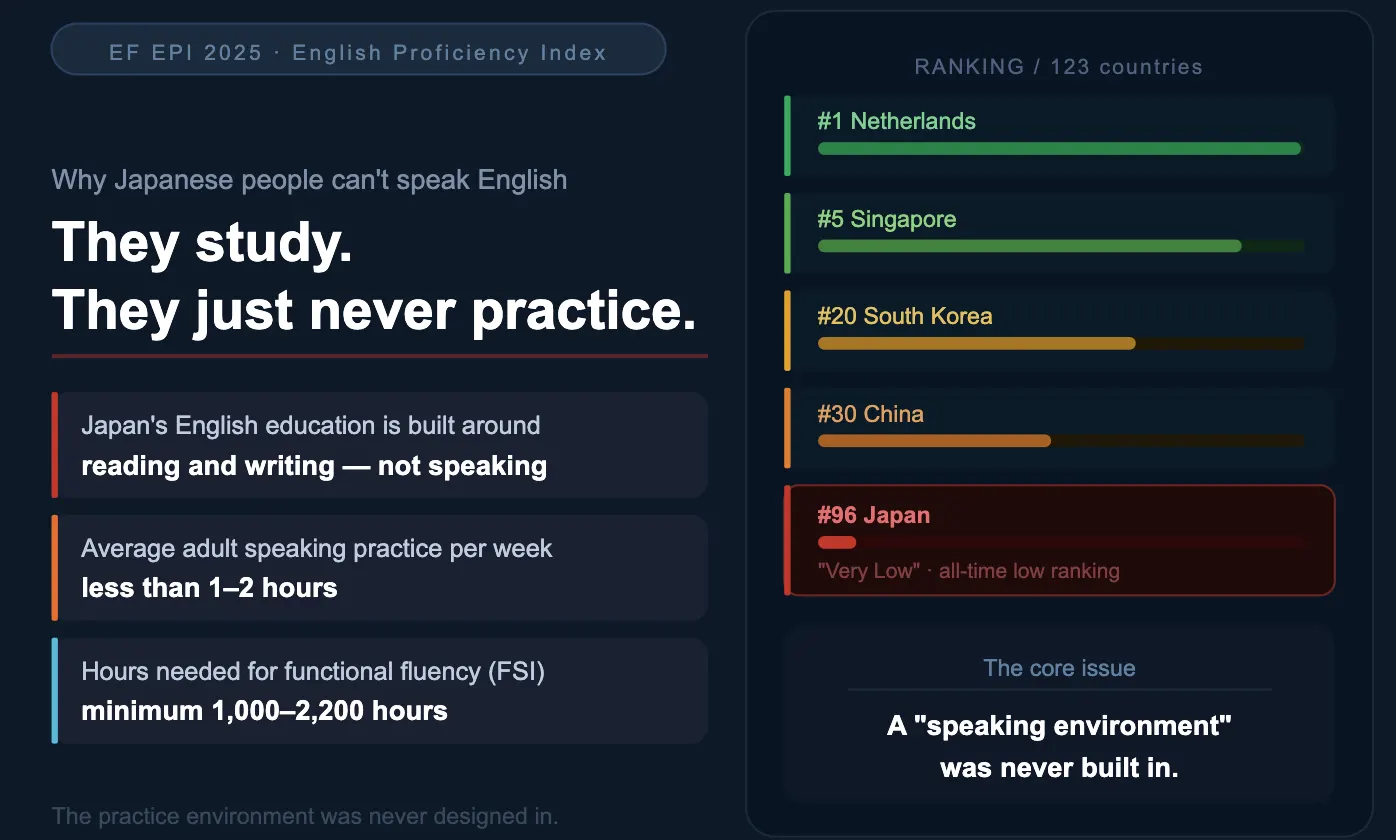
In EF EPI 2025, Japan ranked 96th out of 123 countries and regions. This article reframes the issue from “not studying enough” to the lack of speaking opportunities and practice design, showing why creating places to use English matters for both Japanese learners and foreign residents.
Why Japan’s English proficiency is hard to improve
A lot of people in Japan have the same frustrating experience: they study English for years, but when it is time to speak, nothing comes out.
That does not mean people are lazy or unmotivated. In fact, many learners are working hard. The deeper issue is that English in Japan has long been designed around reading and writing, while speaking opportunities outside the classroom remain limited. In other words, many learners have knowledge, but not enough chances to use it.
EF EPI 2025 ranked Japan 96th out of 123 countries and regions. That result can easily lead to a simple conclusion: “People should study more.” But that explanation misses an important point.
Why this is not just a matter of motivation
When people say “Japanese people should try harder,” they are usually looking at the problem from the outside. But if you look at daily life, the real issue becomes clearer: there are not enough places where people can actually use English.
For many working adults, the total weekly time available for speaking English may be less than one or two hours. That is not enough to turn passive knowledge into active communication. Language does not become usable just because you understand it. It becomes usable when you speak, make mistakes, correct yourself, and repeat the process in a real setting.
That is why the key problem is not only study time. It is the design of practice time.
What is missing in English education in Japan
Japanese English education has its strengths. Reading comprehension, grammar, and test preparation can all be useful. But if learning stops there, many people end up in the same place: they understand English, but they cannot speak it.
This is a common gap in language learning systems. Knowing about English is not the same as using English. A classroom can teach forms and rules, but speaking requires quick response, confidence, and repeated exposure. Those are hard to develop if English is rarely used in everyday life.
In that sense, English should not be treated only as a school subject. It is a tool for connection.
Why speaking opportunities matter more than extra study
When learners have a place to speak, everything changes.
English becomes less intimidating. Learners start to feel that speaking is something they can grow into, not something only fluent people can do. They begin to notice that even imperfect English can still communicate meaning. And once that happens, confidence starts to replace fear.
This matters for Japanese learners, but it also matters for foreign residents in Japan. Many foreigners want opportunities to practice Japanese, meet local people, and build real relationships. A community space that supports both Japanese and English creates a better environment for everyone.
How to create an environment that helps people improve
If you want people to improve, you do not start with pressure. You start with access.
That means creating spaces where people can talk without fear of being judged. Spaces where it is okay to ask questions, make mistakes, and repeat the same phrase until it feels natural. This is especially important for speaking practice, because spoken language is not learned only through study. It is learned through use.
A supportive environment also helps people stay consistent. Many learners do not quit because they are incapable. They quit because they do not have a realistic place to continue. When a practice environment is easy to join and emotionally safe, people are much more likely to keep showing up.
Why this matters for both Japanese learners and foreign residents
For Japanese learners, a speaking environment creates a bridge between study and real communication. It turns vocabulary and grammar from abstract knowledge into something alive.
For foreign residents, it creates a place to belong. In Japan, many people want not just language practice, but meaningful human connection. A community that allows both English and Japanese to be used naturally can help reduce isolation and build local trust.
That is why language exchange is more than a hobby. It can support multicultural coexistence, regional retention, and international career development at the same time.
How Red Look supports international career growth through practice
At Red Look, we believe the answer is not simply “study more.” The answer is to create more opportunities to use language in real life.
That is why we value community spaces where Japanese and foreign residents can learn together, talk together, and grow together. A place like that does more than improve English or Japanese. It helps people gain confidence, discover new perspectives, and build relationships that can support their lives and careers in Japan.
If someone wants to improve English, the first step is not always another textbook. Sometimes the first step is finding a place where English can actually be used. That is often where the real change begins.
Red Look is building that kind of space. If you want a community where language learning connects to real-life exchange and international careers, we would be glad to welcome you.
At Red Look, we create a place where Japanese and foreign residents can learn, speak, and connect together.
If you want to do more than study English and actually use it in real conversations, we invite you to join our community.NPO法人 Red Look
日本人、外国人双方の国際キャリア形成を通じた
持続可能な地域共生を目指して
Recommended for you
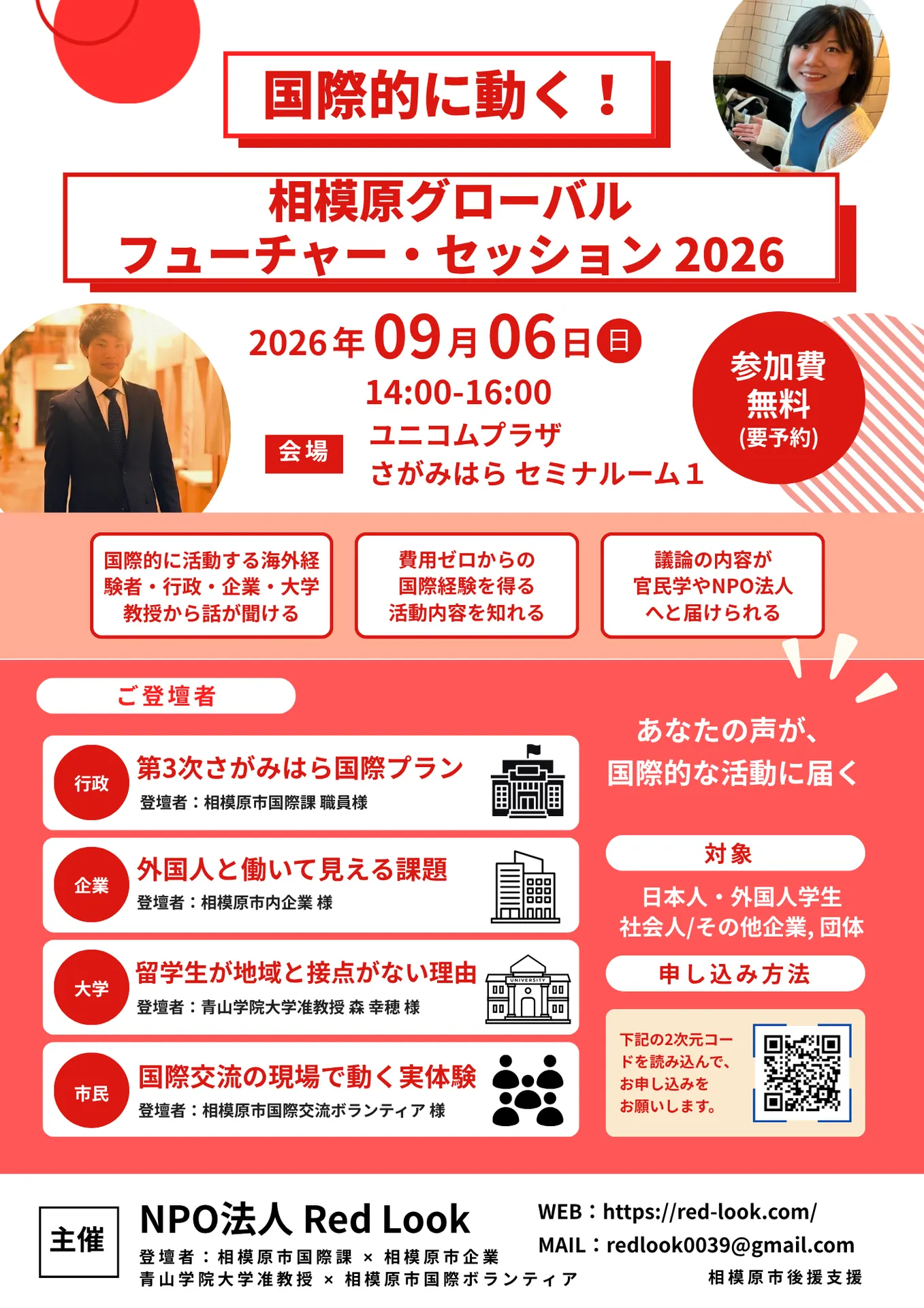
Sagamihara Global Future Session 2026: Connecting Multicultural Communities and Global Careers
2026-07-08
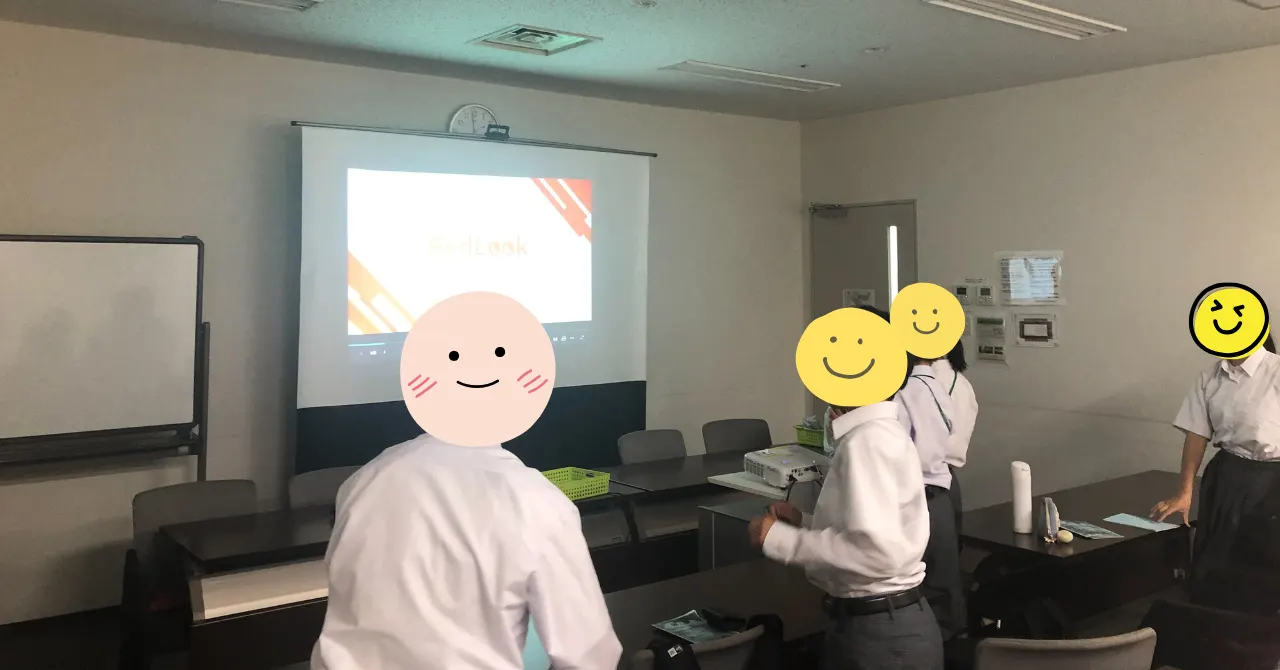
Connecting Junior High School Students with the World | Red Look Delivers an International Understanding Class in Sagamihara
2026-07-03

Studying Japanese but Can't Use It at Work? Red Hub Bridges Language Learning and Your Career in Japan
2026-04-17
Red Look's Next Chapter: Online Community, Government Partnerships, and a City-Endorsed Event in Sagamihara
2026-04-17
Why We Rebuilt Our Vision: From 'Local Job Support' to 'A World Where Everyone Can Connect Globally'
2026-04-16
Interested in working or studying abroad? We’re here to support you.
Red Look is a non-profit organization that helps Japanese individuals take on overseas challenges and supports foreign nationals finding careers in Japan. Our mentors and career coaches will guide you through your global journey. Reach out today!
Get Free Consultation