Interview
From Engineer Community to Nonprofit: Why We Founded Red Look
Funds ran dry, ideas ran out — and still we didn't quit. From launching a tech community in Canada to founding an international NPO, Red Look president Eric shares the origin story.
 By NPO Red LookPublished: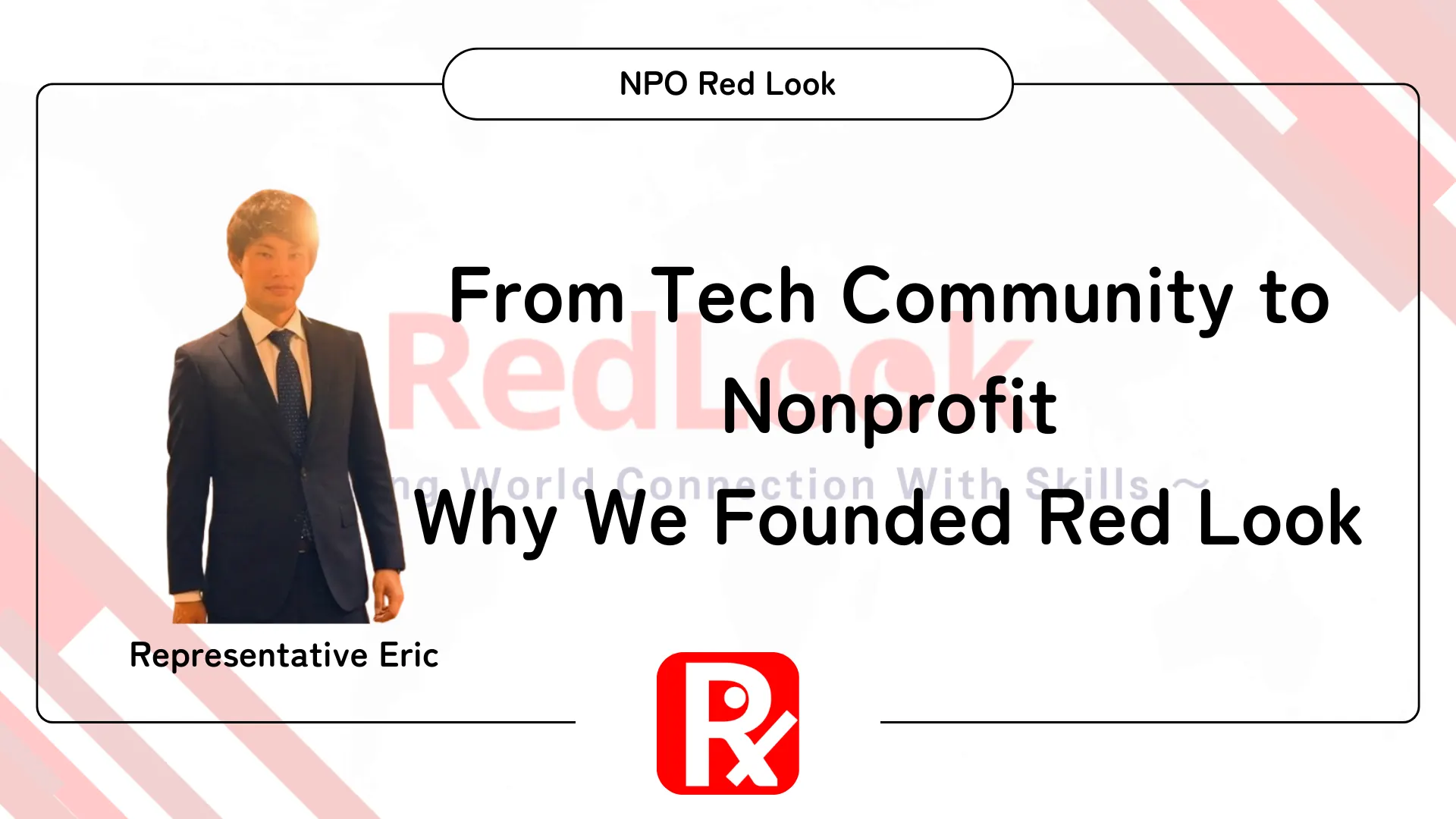
Contents
- Reflecting on Six Months as an International Nonprofit
- Part 1: Why We Founded Red Look as an NPO
- From Student Years to International Pursuits — Why He Dreamed of Becoming a "Global Engineer"
- Why an NPO and Not a Corporation or Sole Proprietorship?
- When Funds Ran Out and Ideas Were Exhausted — Why He Didn't Walk Away
Reflecting on Six Months as an International Nonprofit
Part 1: Why We Founded Red Look as an NPO
"Funds ran dry, ideas ran out — and still we didn't quit." — From engineer community to nonprofit, Eric shares the origin story of Red Look.
Interviewer: Thank you for joining us today. We're here with Eric, president of NPO Red Look.
Eric: Great to be here. Thank you.
Interviewer: Red Look has now been officially incorporated for about six months. To start things off, could you give us a brief overview of your background?
Eric: Sure. I worked as a systems engineer for about two years, then in parallel started taking on projects as a freelance full-stack web developer for about four years. At the same time, I spent roughly three years managing a community I founded overseas, two years as an English and programming coach on Menta, and now six months as president of an NPO.
From Student Years to International Pursuits — Why He Dreamed of Becoming a "Global Engineer"
Interviewer: So what led you to start an NPO in the first place?
Eric: The short answer is that I wanted to preserve the community feel. Things like going out for dinner after events, or being able to casually connect even when there's no event happening. That kind of atmosphere really mattered to me.
Interviewer: When you say "community" — was Red Look originally a community before it became an NPO?
Eric: Exactly. It started as an engineer community — a place for engineers to gather. Looking back, I'd been involved in international activities since my student days: studying abroad, backpacking, supporting international students as a volunteer in Japan. That shaped me. When I graduated, I dreamed of working abroad as a "global engineer," so I quit my job, moved to Canada, and ended up launching a tech community in Vancouver. That was really the starting point.
Interviewer: So it all began in Canada. The website mentions you've hosted over 150 events with more than 1,500 total participants, and expanded to three countries.
Eric: That's right. Over two and a half years, I ran communities in Japan and Canada myself, and a friend launched one in Germany. We had countless planning meetings — good memories.
Why an NPO and Not a Corporation or Sole Proprietorship?
Interviewer: How did things go in the beginning?
Eric: When I first launched in Canada, I was driven like something had possessed me. For a full year without a break, I ran events every Sunday and several times during the week — about 90 events in total (laughs). Along the way, I built a team and we created mobile apps and web apps as development projects. At the time I was still an engineer myself and aiming to land a local job in Canada, so I kept running events focused on algorithm challenges (LeetCode) and showcasing personal projects. It was partly a way to improve my English and build connections.
Interviewer: So founding a company or an NPO wasn't on your radar at all initially.
Eric: Not at all (laughs). I was just doing what I could. But the more I kept at it, the more I realized there were people who genuinely needed this community. Receiving their gratitude shifted my mindset — from "I want to get a job locally" to "I want to grow this community so I can support more people." When I returned to Japan, interacting with foreigners who had come here deepened that feeling. I wanted them to discover more about Japan, and I wanted more people to have meaningful international experiences. In hindsight, I think that desire had been with me since my student days.
When Funds Ran Out and Ideas Were Exhausted — Why He Didn't Walk Away
Interviewer: When did you decide to incorporate?
Eric: Around October 2024, when we were starting to run out of money despite operating without charging for anything. I tried creating paid online packages and looking for financial sponsors, but neither worked out. Ideas dried up too — that was probably the hardest period.
Interviewer: That sounds really tough.
Eric: It was. But the people around me kept me going, and I never seriously thought about quitting. I had such a strong desire to keep going that I decided to incorporate. I went back and forth between starting a company or becoming a sole proprietor, but I knew I didn't want to lose that community spirit — the casual atmosphere where people could enjoy themselves, make mistakes without fear, and go out for dinner after events. And ultimately, I was lucky to meet the right people, which made it possible to establish a nonprofit. Even now, I'm supported by our staff and so many others. If I ever quit, I'd probably get an earful (laughs).
Part 1 Summary Eric's community activities began with an engineer community in Vancouver, Canada, and continued after returning to Japan. At the heart of it all is a desire — one that goes back to his student years — to give people meaningful international experiences. Even through financial hardship with no clear path forward, a deep commitment to preserving the community spirit, combined with the support of those around him, ultimately led to the decision to found Red Look as a nonprofit.
Where to go next
Talk about languages and careers — for free
Staff who have lived and worked across borders will listen to your questions about working abroad or building a life and career in Japan. No sales pitch.
Not sure which fits you? Take our free career assessment (about 8 minutes)
NPO Red Look
A nonprofit in Sagamihara, Kanagawa, Japan, creating a third place where Japanese and international people meet as equals and grow together through languages, friendships, and careers.
About Red Look