Interview
Why We Rebuilt Our Vision: From 'Local Job Support' to 'A World Where Everyone Can Connect Globally'
Through ongoing interviews and fieldwork, the vagueness of our original vision became clear. Red Look president Eric explains the social challenges facing both Japanese nationals and foreign residents — and how they shaped the organization's new vision and mission.
 By NPO Red LookPublished: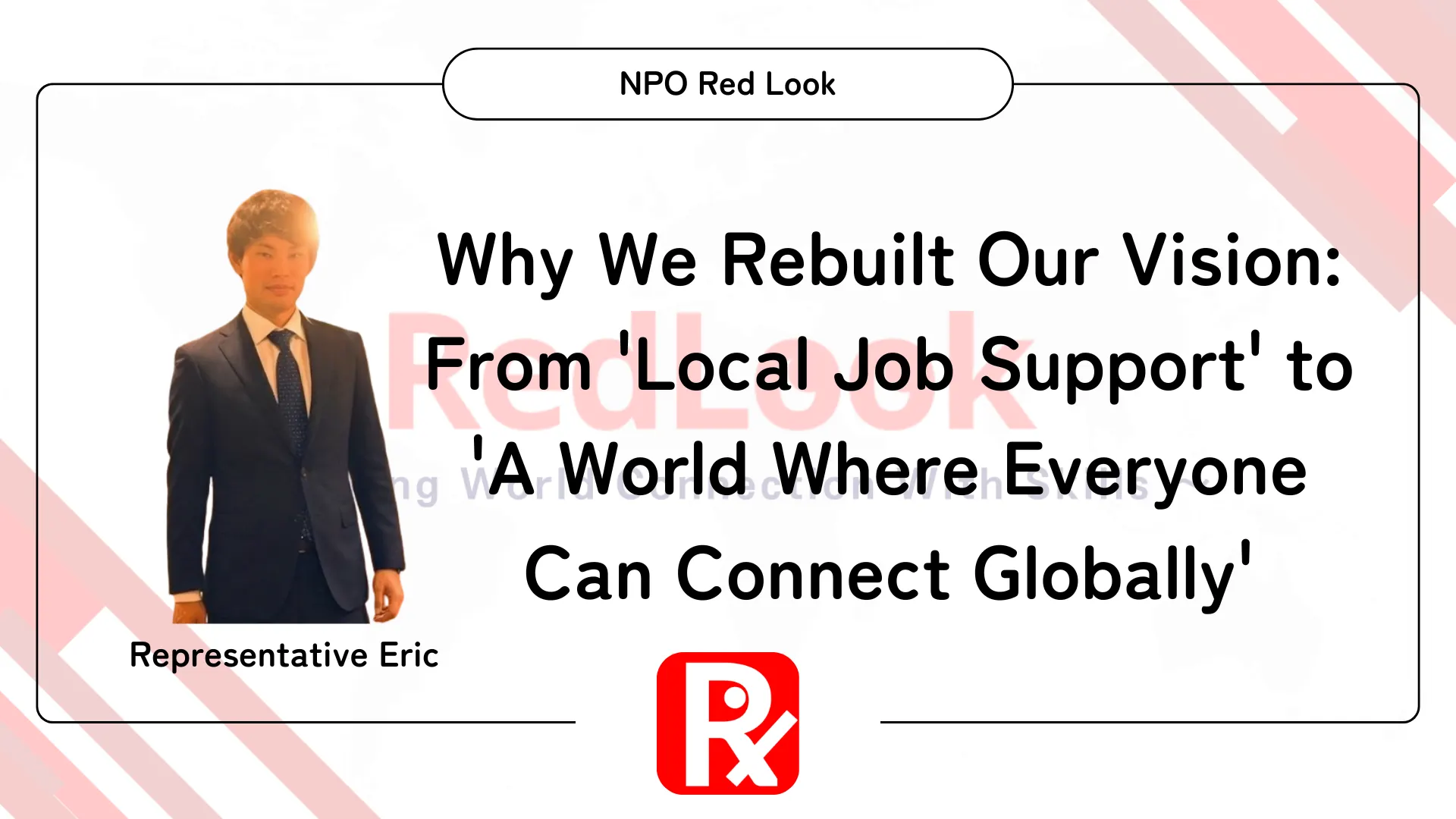
Contents
- Part 2: Looking Back on the First Six Months
- A Packed Six Months — Cold Calling, Drop-In City Hall Visits, and Overseas Sponsor Outreach
- When "Where Are We Headed?" Is Unclear, the Organization Falls Apart
- The Social Challenges That Emerged Through Listening
- "A Society Where Everyone Can Connect with the World in Their Own Way" — The Story Behind the Vision
- Red Look's Strength — Why the Team Is Full of Internationally Experienced People
Part 2: Looking Back on the First Six Months
From "local job support" to "a world where everyone can connect globally" — why Red Look rebuilt its vision from the ground up.
A Packed Six Months — Cold Calling, Drop-In City Hall Visits, and Overseas Sponsor Outreach
Interviewer: Now that you're up and running, how has the journey been so far?
Eric: Genuinely one of the most dense six months of my life — both for the organization and for my own career and personal growth. We've done intern recruitment, visited universities and vocational schools, walked unannounced into city halls in other prefectures to learn about international career initiatives, made cold calls, joined the local chamber of commerce, given talks, handled sponsor inquiries from overseas... and on top of all that, we opened a corporate bank account and got all the necessary tools and contracts in place within the first month.
Interviewer: That's remarkable energy (laughs). If you had to pick the single most important milestone for the organization, what would it be?
When "Where Are We Headed?" Is Unclear, the Organization Falls Apart
Eric: Setting our vision and mission. Because we grew out of a tech community rather than starting as a traditional NPO, we hadn't clearly thought through the social problems we were trying to solve at the time of founding. Our slogan — "Making World Connection With Skills" — and the belief behind it, that skills complement language ability and open up networks, still rings true. But if the team — the organization — can't answer "where are we going with all of this?", things fall apart. That was true when running the community, and it's true for the NPO.
Interviewer: The "local job support" direction didn't seem like a bad one, though?
Eric: I don't think it was bad, honestly. But the more we listened to people in different places, the clearer it became. We kept hearing things like, "going abroad feels financially out of reach," "getting into a foreign company seems beyond my abilities," or "overseas life just sounds scary." The people who said "I really want to get a job abroad!" were actually pretty rare. On the foreign resident side, more than half wanted to work in Japan, yet there were also quite a few voices saying things like "the work conditions at Japanese companies sound brutal" or "Japan is great to visit, but actually living here is another story..." That made my own feelings shift — I became more driven by wanting people to genuinely appreciate Japan, and to build meaningful international experiences, rather than focusing narrowly on overseas employment.
The Social Challenges That Emerged Through Listening
Interviewer: What specific social challenges came into focus?
Eric: On the Japanese side: the number one reason high school and university students give up on studying abroad is financial constraints (Ministry of Education / JASSO "Tobitate! Study Abroad JAPAN" survey on study abroad awareness, February 2024). Related to this is the stagnation of English proficiency in Japan, which makes it increasingly difficult for small and medium-sized enterprises to expand internationally (Source: Small and Medium Enterprise Agency, "White Paper on Small and Medium Enterprises," 2024 edition). Young working adults face the same challenges.
On the foreign resident side: many highly skilled individuals struggle to find employment due to high Japanese language requirements. And social isolation often leads to early resignation or returning home (Ministry of Economy, Trade and Industry, "Study Group on Highly Skilled Foreign Professionals," report dated July 26, 2024). These are the issues we want to address.
"A Society Where Everyone Can Connect with the World in Their Own Way" — The Story Behind the Vision
Interviewer: So those findings shaped the vision you have today.
Eric: Exactly. Regardless of age or nationality, we want to support people across the full spectrum — from those who are just a little curious about the world, to those who are determined to thrive internationally. We're aiming to be the kind of organization people think of first when it comes to anything global or international — one that genuinely listens to each person's experience, opinions, and mindset. Our mission is twofold: supporting international career development for both Japanese nationals and foreign residents, and contributing to regional revitalization in Sagamihara, Kanagawa from an international perspective. We worked through all of this in dialogue with our board members, staff, business owners, and certified SME consultants.
Interviewer: "Everyone" sounds like quite a broad target audience.
Eric: It is (laughs). But that breadth is intentional. By serving a wide range of people, we can raise both the international capability of Japanese people — their ability to engage and thrive globally — and the Japan literacy of foreign residents — their ability to build a life here. Since everyone is at a different level, we want to meet each person where they are.
Interviewer: One thing I noticed: even though you've moved away from the overseas employment focus, the connection to careers is still very much there.
Eric: Sharp observation (laughs). Great question. When living abroad, you need a sustainable income to support yourself — that's just the reality. And many people aren't thinking about going overseas at all; they're studying English now because they'd like to work in Japan someday. From a regional revitalization standpoint too, you can't achieve genuine community development without local employment. If tourism booms too much, you end up with overtourism — simply opening the doors isn't the answer. Maintaining that delicate balance between government, citizens, and international residents is something we see as part of our role as an NPO.
Red Look's Strength — Why the Team Is Full of Internationally Experienced People
Interviewer: Finally, what would you say is the greatest strength of your staff?
Eric: Without question, it's the fact that our staff are deeply knowledgeable about cross-cultural understanding and have rich international experience — and at the same time, every one of them is actively working at the forefront of their own professional field. We have people on our team who've struggled through life abroad, who know what it takes to succeed, and who can genuinely empathize with the challenges immigrants face. I always tell the staff: "Each of you needs to keep being someone who challenges themselves internationally." Even staff members who haven't yet had overseas experience are making the effort — using Duolingo, attending international events on Meetup — and growing through Red Look's culture every day.
[Part 2 Summary] Red Look originally launched with an "overseas job support" direction, but through extensive listening and fieldwork, the team engaged seriously with real social challenges and rebuilt its vision and mission from scratch. "A society where everyone can connect with the world in their own way" was born out of a genuine attempt to address the financial, capability-related, and psychological barriers faced by both Japanese nationals and foreign residents. A team with deep cross-cultural understanding, international experience, and a personal commitment to ongoing growth — that is Red Look's greatest asset.
Where to go next
Talk about languages and careers — for free
Staff who have lived and worked across borders will listen to your questions about working abroad or building a life and career in Japan. No sales pitch.
Not sure which fits you? Take our free career assessment (about 8 minutes)
NPO Red Look
A nonprofit in Sagamihara, Kanagawa, Japan, creating a third place where Japanese and international people meet as equals and grow together through languages, friendships, and careers.
About Red Look