Blog
Passed the JLPT but Can't Speak Japanese? How to Practice Speaking for Free
You can read the kanji and follow the listening test, but when someone talks to you, the words don't come out. Here's why that happens, five free ways to practice speaking Japanese with real people, and a simple weekly routine that works.
 By Eric (Yutaro Akami)Representative Director, NPO Red LookPublished:
Contents
Short answer: Speaking is a separate skill from reading and listening, and it only grows when you actually talk with people. The JLPT does not test speaking at all, so many people pass it without ever practicing conversation. The most reliable free fix is a regular language exchange — online or in person — where you speak Japanese every week and help a Japanese speaker with your language in return.
Why passing the JLPT doesn't mean you can speak
If you can read a news article but freeze when a coworker asks about your weekend, you are not alone — and it is not a sign that your study was wasted.
The JLPT measures language knowledge (vocabulary and grammar), reading, and listening. According to the official JLPT FAQ, it does not include a conversation or composition test (JLPT FAQ). So it is completely possible to prepare well for the test without ever saying a full sentence out loud to another person.
Speaking needs things that textbooks and apps cannot give you:
- Retrieving words under time pressure. In conversation, you have a second or two, not a minute.
- Getting stuck and recovering. Saying "えっと…" and rephrasing is a skill you only learn by doing it.
- Hearing real, casual Japanese. Contractions, fillers, and speed that rarely appear in test audio.
The good news: once you start speaking regularly, all of that knowledge you built for the JLPT becomes very useful, very quickly.
5 free ways to practice speaking Japanese
| Way | Good for | Things to know |
|---|---|---|
| Online language exchange | Regular practice from anywhere, including outside Japan | Small groups with a topic are easier than open, unstructured calls |
| In-person language exchange | Practice plus making friends | Choose small, regular events over big parties so you see the same people again |
| Local international associations | Volunteer-run Japanese classes and cultural events | Most prefectures and many cities have one — see CLAIR's list |
| Language exchange apps | Short practice in spare moments | Chats often stay in text; move to voice calls to actually practice speaking. Be careful with personal information |
| Your daily life | Free practice you already have | Use Japanese at shops, the city office, or with coworkers — even short exchanges count |
Online language exchange
Japanese speakers who want to practice English and international people who want to practice Japanese meet on a video call. It is free in many communities, and because it has a fixed time each week, it is one of the easiest ways to build a habit. If you live outside Japan, this is often the best option.
In-person language exchange
Meeting face to face makes conversations last longer, and it is the easiest way to turn practice partners into friends. We wrote a whole guide to this in How to Make Friends in Japan as a Foreigner.
Local international associations
Many cities run free or low-cost Japanese classes taught by local volunteers. They are a good place to practice polite, everyday Japanese and to meet people in your area.
Language exchange apps
Apps are convenient, but text chat is not speaking practice. If you use one, suggest a short voice call once you are comfortable, and never share your address, workplace, or financial details with someone you have not met.
Your daily life
Ask the staff a question instead of pointing. Say a few more sentences than you need to. Small, low-pressure moments add up.
What happens at an online language exchange
NPO Red Look runs a free weekly online language exchange in English and Japanese. Here is how a session usually goes, so you know what to expect from this kind of event:
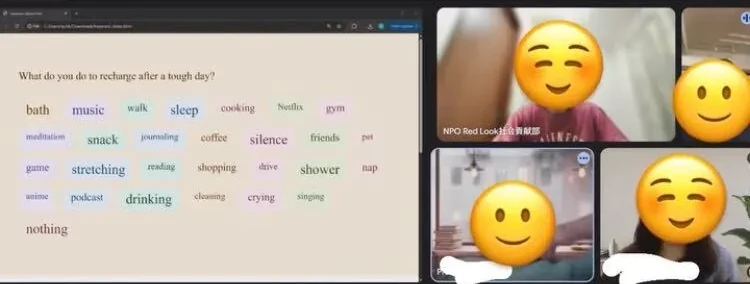 A weekly online session (faces are hidden)
- Greetings and short introductions — join on Google Meet and say hello.
- Talk about a topic — in small groups, using both English and Japanese. Topics vary by host: daily life, news, and sometimes skills such as AI or LinkedIn, or careers.
- One-line share — at the end, everyone shares something they talked about or noticed.
Each session is about 45 minutes and free, and you can join from anywhere. Dates are announced on Meetup in Japan Standard Time. On Meetup, the weekly online event is rated 4.8 out of 5 (77 ratings, 550 members, as of October 2026).
How to prepare so the words come out
- Prepare a 30-second self-introduction in Japanese. Name, where you are from, what you do, why you are learning Japanese, and one thing you like. You will use it again and again.
- Write down three questions you can ask. 「休みの日は何をしていますか?」「おすすめの食べ物はありますか?」「英語はどうやって勉強していますか?」
- Learn your "rescue phrases". 「すみません、もう一度お願いします」「〇〇は英語で何ですか?」「ゆっくり話してもらえますか?」
- Help the other person with English. When both sides are learners, nobody feels judged, and the conversation keeps going.
A simple weekly routine
- Speak once a week, every week. One fixed session beats three random ones.
- Take three minutes of notes afterward. Write down what you wanted to say but couldn't, look it up, and use it next time.
- Go back to the same group. Familiar faces mean less nerves and more speaking time.
- Add one in-person event per month if you live in or near Tokyo or Kanagawa.
FAQ
Does the JLPT test speaking?
No. According to the official JLPT FAQ, the test does not include a conversation or composition section. It measures language knowledge, reading, and listening.
How can I practice speaking Japanese for free?
Join a regular language exchange (online or in person), a volunteer-run Japanese class at a local international association, or use Japanese actively in daily life. A fixed weekly session is the easiest way to build the habit.
What level do I need to join a language exchange?
There is no fixed level. Beginners can use simple Japanese and switch to English when needed. Being able to introduce yourself and ask a few questions is enough to start.
Can I join from outside Japan?
Yes, online language exchanges are open to people anywhere. Check the time zone — Red Look's sessions are announced in Japan Standard Time (JST).
When is the next JLPT?
The second JLPT of 2026 is on Sunday, December 6, 2026, and in some cities outside Japan it is held only in July or December (JLPT test dates). Practicing speaking alongside test prep helps your listening, too.
Sources
- JLPT official website, FAQ: Does the JLPT include a conversation or composition test?
- JLPT official website, Test dates (overseas)
- CLAIR, International Associations
Checked on October 7, 2026.
Try speaking once this week
Red Look's weekly online language exchange is a free, 45-minute session where Japanese and international people practice English and Japanese together in small groups. You don't need perfect Japanese, and there is no sales pitch — we are a nonprofit. If you want to understand why Japanese feels so hard in the first place, read Why is Japanese So Hard to Learn?.
Where to go next
Try talking at our weekly online exchange
A free online language exchange once a week, in English and Japanese. You don't need perfect English or Japanese.
Not sure which fits you? Take our free career assessment (about 8 minutes)
Eric (Yutaro Akami)
Representative Director, NPO Red Look
Founded and ran international communities in Canada, Germany, and Japan. Established NPO Red Look in 2025 and serves as its Representative Director.
About Red Look